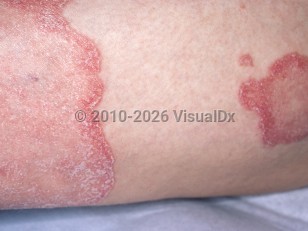

Pustular psoriasis may occur in children but is more commonly seen in middle-aged adults. It is also found more frequently in Asian and Hispanic individuals than in White individuals.
The etiology of pustular psoriasis is incompletely understood, but cases have been associated with hypocalcemia, infection (Trichophyton rubrum, cytomegalovirus, Streptococcus spp, varicella-zoster virus, and Epstein-Barr virus), a rapid withdrawal of corticosteroids, pregnancy, medications (NSAIDs, lithium, potassium iodine, trazodone, penicillin, interferon, and hydroxychloroquine), and topical irritants such as tar and anthralin. While tumor necrosis factor (TNF)-alpha antagonists such as infliximab and adalimumab are used to treat pustular psoriasis, they have also been reported paradoxically to induce it.
Additionally, there is emerging evidence that pustular psoriasis is associated with mutations in the IL36RN gene that encodes the interleukin-36 receptor antagonist (IL-36RA). Mutations in this gene have been detected in different variants of pustular psoriasis, including generalized pustular psoriasis, pustular psoriasis of pregnancy, palmoplantar pustulosis, and the exanthematic type of pustular psoriasis. Deficiency of IL-36RA (DITRA) syndrome is an autoimmune inflammatory disorder caused by loss of function mutations in the IL36RN gene that manifests in early childhood with generalized pustular psoriasis, fever, leukocytosis, and elevated C-reactive protein (CRP) levels.
There are 3 subtypes of generalized pustular psoriasis:
- von Zumbusch type – Acute onset of generalized erythema and pustules with systemic manifestations including fever, skin tenderness, malaise, arthralgias, headache, and nausea. After several days, the pustules resolve to become confluent, scaling plaques.
- Exanthematic type – Acute onset of small pustules that are triggered by an infection or a drug. This subtype usually lacks systemic symptoms.
- Annular subtype – Erythematous, annular lesions that have pustules at the advancing edge of a lesion. This subtype is associated with fever, malaise, and other systemic manifestations. The annular variant is the most common form of pustular psoriasis in children.
Extracutaneous manifestations of generalized pustular psoriasis may be severe. The most common extracutaneous manifestations include cholestasis, cholangitis, arthritis, intestinal pneumonitis, oral lesions, and acute renal failure. Electrolyte disturbances such as hypocalcemia may occur and can be life-threatening. Lesions may also become superinfected.
Additionally, localized patterns of pustular psoriasis occur:
- Pustular psoriasis may be preceded by or may coexist with plaque psoriasis. Pustular psoriasis flares can be induced by infection, a rapid withdrawal of corticosteroids, medications, and topical irritants. More recently, COVID-19 infection has been shown to trigger pustular flares of psoriasis.
- Palmoplantar pustular psoriasis is the most common form of localized pustular psoriasis.
- Localized patterns include acrodermatitis continua of Hallopeau, in which the distal digits are primarily involved.